
Development of a Learning Management Model Using the Design Thinking Process to Enhance Electronic Teaching Media Production for Pre-Service Teachers at Lampang Rajabhat University
Keywords:
learning management model, design thinking, electronic teaching media, electronic teaching media production skillsAbstract
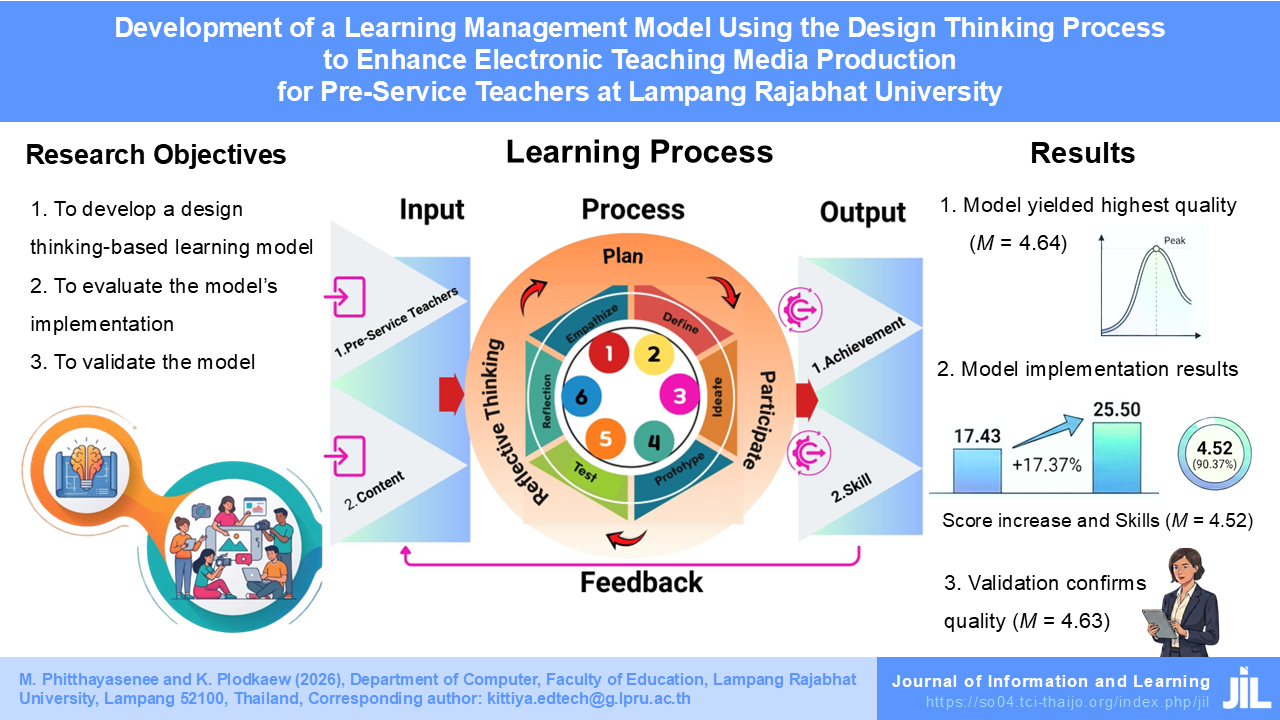
This research aimed 1) to develop a learning management model using the design thinking process to enhance electronic teaching media production for pre-service teachers at Lampang Rajabhat University, 2) to examine the effects of the model, including comparing learning achievement before and after implementation and evaluating students’ media production skills against the 80% criterion, and 3) to validate the developed model. The target group consisted of 14 fourth-year pre-service teachers. The research instruments comprised: a learning management model using the design thinking process, a learning achievement test, an electronic teaching media production skills assessment form, and a model validation assessment form. Data were analyzed using mean and standard deviation. The findings revealed that the developed design thinking–based learning management model was rated at the highest quality level (M = 4.64, SD = 0.52). The dimension receiving the highest mean score was the learning management process (M = 4.70, SD = 0.51), followed by outcomes (M = 4.63, SD = 0.50) and input (M = 4.60, SD = 0.55). Following implementation, pre-service teachers’ learning achievement increased from 17.43 (SD = 0.85) to 25.50 (SD = 1.45). Their electronic instructional media production skills reached a high level (M = 4.52, SD = 0.48), equivalent to 90.37%, exceeding the 80% criterion. Expert validation of the learning management model using the design thinking process indicated the highest quality level (M = 4.63, SD = 0.49).
References
Abdulrahaman, M. D., Faruk, N., Oloyede, A. A., Surajudeen-Bakinde, N. T., Olawoyin, L. A., Mejabi, O. V., Imam-Fulani, Y. O., Fahm, A. O., & Azeez, A. L. (2020). Multimedia tools in the teaching and learning processes: A systematic review. Heliyon, 6(11), Article e05312. https://doi.org/10.1016/j.heliyon.2020.e05312
Almagrashi, A., Alharbi, E., & Alrowaili, M. (2025). Effect of gamified, mobile, cloud-based learning management system (GMCLMS) on student engagement and achievement. International Journal of Educational Technology in Higher Education, 22, Article 48. https://doi.org/10.1186/s41239-025-00541-1
Alvarado, L. F. (2025). Design thinking as an active teaching methodology in higher education: A systematic review. Frontiers in Education, 10, Article 1462938. https://doi.org/10.3389/feduc.2025.1462938
Aprianto, M. T. P., Kuswandi, D., & Soepriyanto, Y. (2023). Memperkuat keterampilan berpikir kreatif melalui model pembelajaran proyek berlandaskan metode design thinking [Strengthening creative thinking skills through project-based learning model based on design thinking method]. Jurnal Kajian Teknologi Pendidikan, 6(3), 132–142. https://doi.org/10.17977/um038v6i32023p132
Arsita, G. A. M. L., & Astawan, I. G. (2022). Improving student learning outcomes in online learning by using electronic teaching materials. Journal for Lesson and Learning Studies, 5(2), 199–209. https://doi.org/10.23887/jlls.v5i2.48067
Binbai, S. (2025). The effect of learning management using a design thinking approach on enhancing innovative thinking skills of pre-service teachers: A case study of Islamic studies teaching students. Journal of Information and Learning, 36(3), e280259. https://so04.tci-thaijo.org/index.php/jil/article/view/280259
Choi, H., Kim, H., & Kim, N. (2024). Enhancing creativity through a problem-based design thinking project in higher education. Cogent Education, 11(1), Article 2378272. https://doi.org/10.1080/2331186X.2024.2378272
Dei, P. R. (2024). Role of media and technology in the digital era of 21st century education. International Journal of Scientific Research in Engineering and Management, 8(3). https://doi.org/10.55041/IJSREM29820
Eamcharoen, P. (2024). Design thinking for creating educational innovations for teachers in the digital age. Journal of Industrial Education, 23(2), C1–C12. https://doi.org/10.55003/JIE.23203
Firdaus, H., Syafrizal, S., & Nulhakim, L. (2024). Electronic teaching materials to improve student learning effectiveness in automotive vocational high schools. Jurnal Penelitian Pendidikan IPA, 10(11), 9791–9798. https://doi.org/10.29303/jppipa.v10i11.7338
FutureSkill. (2024, April 24). 10 essential skills checklist. FutureSkill. https://futureskill.co/blog/2024/04/24/10-skill-for-true-to-content-creator
Guaman-Quintanilla, S., Everaert, P., Chiluiza, K., & Valcke, M. (2022). Impact of design thinking in higher education: A multi-actor perspective on problem solving and creativity. International Journal of Technology and Design Education, 33, 217–240. https://doi.org/10.1007/s10798-021-09724-z
Hasso Plattner Institute of Design at Stanford. (2010). An introduction to design thinking process guide. Stanford University. https://web.stanford.edu/~mshanks/MichaelShanks/files/509554.pdf
Henriksen, D., Richardson, C., & Shack, K. (2020). Mindfulness and creativity: Implications for thinking and learning. Thinking Skills and Creativity, 37, Article 100689. https://doi.org/10.1016/j.tsc.2020.100689
Inkaew, C., & Napapongs, W. (2025). Problem-based learning integrated with design thinking process to enhance creative thinking skills in digital photography for educational communications. Journal of Information and Learning, 36(1), Article e272723. https://so04.tci-thaijo.org/index.php/jil/article/view/272723
Kaewurai, R., Lincharoen, A., Phitthayasenee, M., Noysakun, R., & Wannakhao, C. (2023). Developing indicators of digital technology competencies of student teachers. Journal of Information and Learning, 34(2), 52–63. https://so04.tci-thaijo.org/index.php/jil/article/view/261495
Li, T., & Zhan, Z. (2022). A systematic review on design thinking integrated learning in K-12 education. Applied Sciences, 12(16), Article 8077. https://doi.org/10.3390/app12168077
Luka, I. (2019). Design thinking in pedagogy: Frameworks and uses. European Journal of Education, 54(4), 499–512. https://doi.org/10.1111/ejed.12367
Mahapho, C., Mangkhang, C., & Kaewpanya, N. (2023). Learning management using the design thinking process to develop conceptual thinking skills on the topic: Cooperation of countries in the Southeast Asian region. Academic Journal of the Eastern Institute of Technology of Suvarnabhumi, 2(2), 49–57. https://so09.tci-thaijo.org/index.php/JEITS/article/view/1563
Özkan, A., Çevik, İ., Saylan, E., & Çakıroğlu, Ü. (2025). The past and present of instructional design in online learning: Trends and emerging directions. The International Review of Research in Open and Distributed Learning, 26(3), 126–148. https://doi.org/10.19173/irrodl.v26i3.8507
Pande, M., & Bharathi, S. V. (2020). Theoretical foundations of design thinking: A constructivism learning approach to design thinking. Thinking Skills and Creativity, 36, Article 100637. https://doi.org/10.1016/j.tsc.2020.100637
Perdana, B., & Sutabri, T. (2024). Desain UI/UX aplikasi mobile LMS dengan metode design thinking untuk efektifitas pembelajaran mahasiswa di perguruan tinggi. Jurnal Syntax Admiration, 5(12), 5735–5742. https://doi.org/10.46799/jsa.v5i12.1925
Phitthayasenee, M. (2025). Development of electronic teaching materials using design thinking process. Faculty of Education, Rajabhat Lampang University.
Phitthayasenee, M., Sengsri, S., Na Takuatoong, O., & Sengsri, T. (2022). Factors of blended learning model through design thinking process with practicum experience to enhance teacher students' innovatorship. Journal of Information and Learning, 33(3), 22–33. https://so04.tci-thaijo.org/index.php/jil/article/view/257888
Phitthayasenee, M., Sengsri, S., & Sirichaisin, K. (2020). Guidelines for the development of digital technology competency of teacher students Rajabhat University. Lampang Rajabhat University Journal, 9(1), 64–73. https://so04.tci-thaijo.org/index.php/JLPRU/article/view/240660
Phitthayasenee, M., & Yuangsoi, P. (2021). Design thinking: Innovative teachers in the new normal. Lampang Rajabhat University Journal, 10(2), 190–199. https://so04.tci-thaijo.org/index.php/JLPRU/article/view/246560
Ranieri, M. (2019). Creativity and media production in schools. In R. Hobbs, P. Mihailidis, G. Cappello, M. Ranieri, & B. Thevenin (Eds.), The international encyclopedia of media literacy. John Wiley & Sons. https://doi.org/10.1002/9781118978238.ieml0132
Razzouk, R., & Shute, V. (2012). What is design thinking and why is it important? Review of Educational Research, 82(3), 330–348. https://doi.org/10.3102/0034654312457429
Reyna, J., Hanham, J., & Meier, P. (2017). A taxonomy of digital media types for learner-generated digital media assignments. E-Learning and Digital Media, 14(6), 309–322. https://doi.org/10.1177/2042753017752973
Rosetti, C. (2021). Learning management system (LMS) use with online instruction. International Journal of Technology in Education, 4(1), 68–92. https://doi.org/10.46328/ijte.36
Shek, D. T., Chau, G. C. C., & Lee, B. M. (2025). Development of 21st-century skills: A comprehensive analysis based on the OECD learning compass 2030. In Promoting Holistic Development in University Students. Quality of Life in Asia, vol 17. Springer. https://doi.org/10.1007/978-981-96-0251-3_4
Srisa-ard, B. (2017). Kānwičhai bư̄angton [Basic research] (10th ed.). Suweeriyasan.
Srisakam, S., & Supakitjaroen, A. (2024). Developing digital media production skills to create engagement through design thinking process. Journal of Mass Communication Technology, 9(1), 97–116. https://so05.tci-thaijo.org/index.php/jmctrmutp/article/view/273214
Stefaniak, J. E. (2023). Advanced instructional design techniques: Theories and strategies for complex learning. Routledge. https://doi.org/10.4324/9781003287049
Suryani, S., Minarni, A., & Hasratuddin, H. (2025). Classroom management: Boosting student success—a meta-analysis review. Cogent Education, 12(1), Article 2458630. https://doi.org/10.1080/2331186X.2025.2458630
UNESCO, ITU, UNICEF, & GPE. (2024). Six pillars for the digital transformation of education. UNESCO Global Education Coalition. https://profuturo.education/wp-content/uploads/2024/10/Six-pillars-for-the-digital-transformation-of-education_compressed-1.pdf
Woraphongphat, N. (2024). Design and development of a blended training system to enhance instructional media creation skills using Canva for education for teachers in Ratchaburi, Saraburi, and Nakhon Pathom school clusters. Journal of Perspectives in Education, 2(1), 38–52. https://so10.tci-thaijo.org/index.php/JPE/article/view/866
Yu, Q., Yu, K., & Lin, R. (2024). A meta-analysis of the effects of design thinking on student learning. Humanities and Social Sciences Communications, 11(1), 1–12. https://doi.org/10.1057/s41599-024-03237-5
Zaw Oo, T., Kadyirov, T., Kadyjrova, L., & Jozsa, K. (2024). Design-based learning in higher education: Its effects on students’ motivation, creativity and design skills. Thinking Skills and Creativity, 53, Article 101621. https://doi.org/10.1016/j.tsc.2024.101621
Downloads
Additional Files
Published
How to Cite
Issue
Section
Categories
License
Copyright (c) 2026 Journal of Information and Learning

This work is licensed under a Creative Commons Attribution-NonCommercial 4.0 International License.
The Journal of Information and Learning is operated by the Office of Academic Resources, Prince of Songkla University. All articles published in the journal are protected by Thailand copyright law. This copyright covers the exclusive rights to share, reproduce and distribute the article, including in electronic forms, reprints, translations, photographic reproductions, or similar. Authors own copyrights in the works they have created as well as the Office of Academic Resources. The Journal reserves the right to edit the language of papers accepted for publication for clarity and correctness, as well as to make formal changes to ensure compliance with the journal's guidelines. All authors must take public responsibility for the content of their paper.


